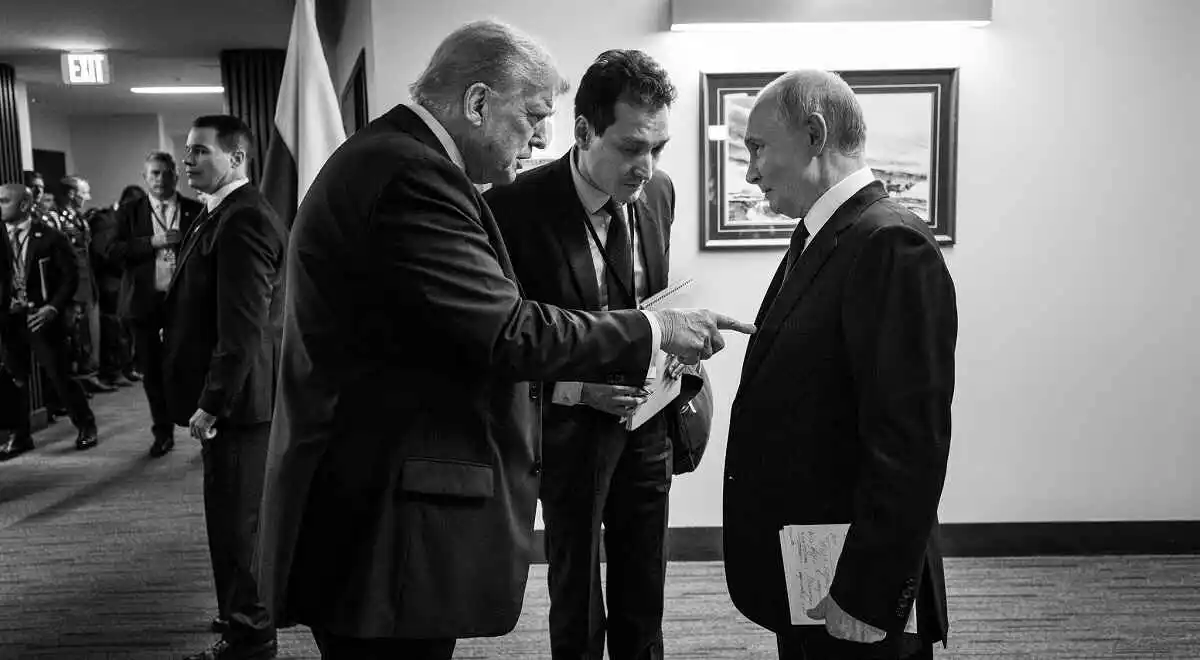
After years of near-total military estrangement, the United States and Russia have agreed to re-establish high-level military-to-military dialogue, marking one of the most consequential yet understated shifts in global security since the start of the Ukraine war. The agreement, reached on the margins of talks in Abu Dhabi, comes at a moment when the world’s nuclear order is under unprecedented strain.
While framed officially as a mechanism to avoid “miscalculation and unintended escalation,” the renewed dialogue carries implications far beyond Washington and Moscow. From Europe’s battlefield anxieties to Asia’s nuclear calculations and the Global South’s demand for strategic stability, this development signals a cautious recalibration in an increasingly polarized world.
Why This Dialogue Matters Beyond Ukraine
At first glance, the announcement by US European Command appears procedural: senior commanders reopening communication channels suspended in 2021, shortly before Russia’s full-scale invasion of Ukraine. In reality, the decision reflects a deeper recognition that unmanaged rivalry between nuclear powers is becoming too dangerous to sustain.
For decades, even during the Cold War’s most volatile moments, the US and Soviet Union maintained military communication to prevent accidental war. The suspension of these contacts after 2021 created a vacuum at a time when:
-
Russian drones and aircraft repeatedly entered NATO airspace
-
US unmanned systems operated close to Russian forces in Syria and the Black Sea
-
Military encounters occurred without reliable crisis-management mechanisms
The resumption of dialogue suggests that both sides now see risk reduction as a global responsibility, not a concession.
Europe’s Perspective: Stability Without Illusions
For Europe, the renewed military dialogue offers limited reassurance rather than strategic relief. European capitals remain deeply skeptical of Moscow’s intentions, particularly as the war in Ukraine continues with no comprehensive settlement in sight.
However, European security planners also understand a hard reality:
Europe is the primary theater where any US-Russia escalation would unfold first.
From Berlin to Paris to Warsaw, the re-establishment of military communication is viewed as:
-
A necessary tool to prevent miscalculation
-
A buffer against accidental NATO-Russia confrontation
-
A temporary stabilizer, not a peace guarantee
Importantly, the talks do not signal a rollback of sanctions or a shift in NATO’s military posture. Instead, they reflect an attempt to manage confrontation rather than resolve it.
The Nuclear Angle: New START and the Risk of a Legal Vacuum
Perhaps the most globally significant dimension of the Abu Dhabi talks is their connection to the New START nuclear arms reduction treaty, which is due to expire imminently.
Under New START:
-
Each side is limited to 1,550 deployed strategic nuclear warheads
-
No more than 700 deployed missiles or bombers are permitted
-
Verification mechanisms provide transparency and predictability
If the treaty expires without replacement or extension, it would leave the US and Russia — for the first time in over 50 years — without any legally binding limits on their nuclear arsenals.
Why This Alarms the World
-
Asia fears knock-on effects on China-US nuclear dynamics
-
Non-nuclear states see arms control norms eroding
-
Global non-proliferation regimes risk losing credibility
Russia has expressed regret over the treaty’s expiry and signaled readiness to engage. President Donald Trump, however, has publicly criticized New START as flawed, calling instead for a “new, improved, and modernized” treaty.
This divergence suggests the dialogue is less about preserving the old order and more about negotiating the shape of a new nuclear framework.
The UAE Factor: Why Abu Dhabi Matters
The choice of Abu Dhabi as the venue is itself geopolitically revealing. The UAE has increasingly positioned itself as a neutral diplomatic hub, capable of hosting talks between adversaries without ideological baggage.
For the Global South, this shift away from traditional Western venues underscores a broader trend:
-
Multipolar diplomacy
-
Regional actors facilitating global security discussions
-
Declining monopoly of Euro-Atlantic mediation spaces
This matters because global security decisions are no longer seen as the exclusive domain of Washington, Moscow, or Brussels.
Global South View: Stability Over Alignment
For many countries in Asia, Africa, and Latin America, the renewed US-Russia military dialogue is welcomed not as a political thaw, but as a pragmatic step to reduce systemic risk.
These states are less concerned with ideological narratives and more focused on:
-
Preventing nuclear escalation
-
Avoiding economic shocks triggered by great-power conflict
-
Preserving global trade and energy stability
From this perspective, military communication between rival powers is seen as a minimum requirement of responsible global leadership, not a diplomatic favor.
A Controlled Rivalry, Not a Reset
Despite headlines suggesting rapprochement, this development does not amount to a reset in US-Russia relations. Key realities remain unchanged:
-
The war in Ukraine continues
-
Sanctions remain firmly in place
-
NATO and Russia still view each other as strategic adversaries
What has changed is the recognition that unmanaged hostility carries unacceptable global risks, especially in an era of advanced weapons systems, AI-driven military decision-making, and compressed response times.
The re-established dialogue is best understood as an attempt to institutionalize controlled rivalry — competition with guardrails.
A Small Step With Global Consequences
The decision by the US and Russia to reopen military communication channels may appear technical, but its implications are profoundly global. In a fractured international system marked by overlapping crises, this move represents a rare moment of convergence on a basic principle:
Strategic competition must not be allowed to spiral into catastrophic miscalculation.
Whether this dialogue evolves into a new arms control framework or remains a narrow crisis-management tool will shape not just US-Russia relations, but the future of global nuclear stability itself.
the world is watching — cautiously — as the two largest nuclear powers test whether dialogue can still function in an age defined by distrust.