
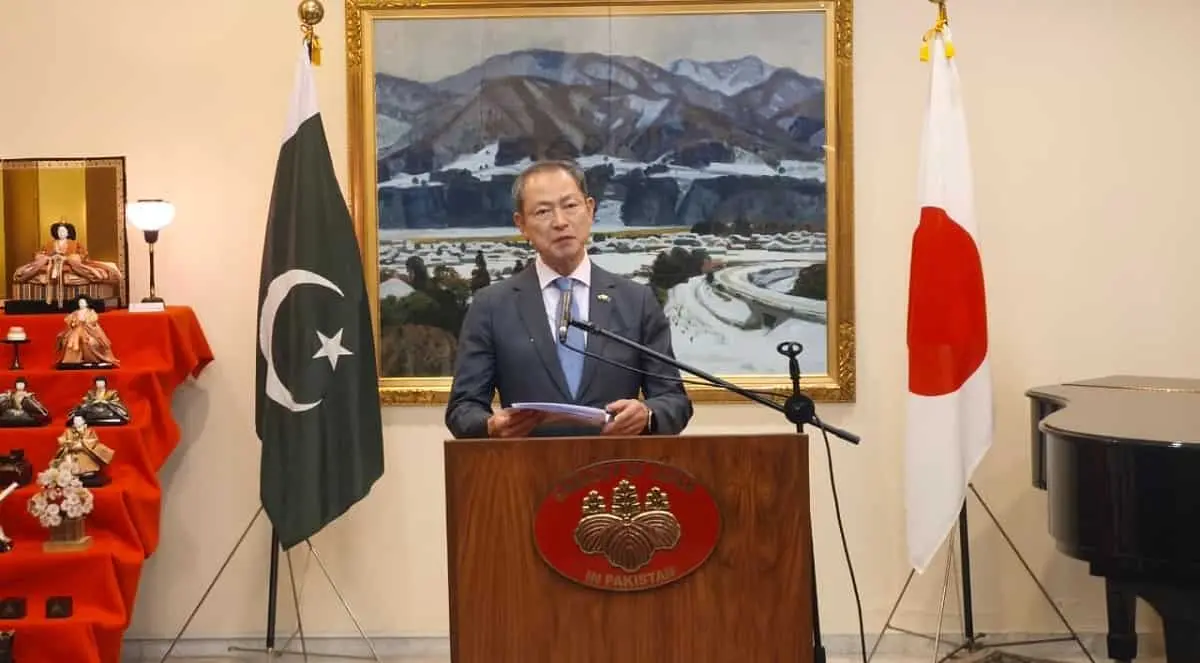
Japan and Pakistan are marking 74 years of diplomatic relations, a milestone that reflects one of Asia’s most consistent and trust-based bilateral partnerships. At a time when global alliances are being reshaped by geopolitical uncertainty, Japan–Pakistan relations stand out for their durability, people-centric approach, and forward-looking agenda.
Speaking at a Media Networking Get-Together hosted at his residence H.E. Mr. Akamatsu Shuichi, Ambassador of Japan to Pakistan, outlined a comprehensive roadmap for the future—one rooted in people-to-people exchanges, economic and technological collaboration, and cultural diplomacy. His remarks offered rare insight into how Japan views Pakistan not just as a development partner, but as a long-term strategic and societal ally.
Ambassador Akamatsu’s First Impressions: Culture, History, and Human Connection
Since assuming office in November 2024, Ambassador Akamatsu has undertaken extensive travel across Pakistan, visiting Punjab and Sindh’s industrial hubs, as well as historical and cultural landmarks including Mohenjo-daro, Taxila, and the Northern Areas.
Reflecting on these journeys, the Ambassador emphasized the depth of Pakistan’s civilizational heritage and the warmth of its people.
“Each visit has left unforgettable memories and deep appreciation for its rich history and culture,”
— H.E. Akamatsu Shuichi
These experiences, he noted, have reinforced Japan’s belief that mutual respect and cultural understanding are the foundation of sustainable diplomatic relations.
Why Pakistan Trusts Japan: ODA, Industry, and Reliability
One of the most striking observations shared by Ambassador Akamatsu was the deep reservoir of trust and affection that Pakistani society holds for Japan.
“One of the things that has impressed me most since I arrived in Pakistan is the trust and affection that the people of Pakistan have for Japan,”
— Ambassador Akamatsu
He attributed this goodwill to several long-standing pillars:
-
74 years of uninterrupted diplomatic relations
-
Japan’s Official Development Assistance (ODA) across infrastructure, health, and education
-
The sustained presence of Japanese companies in Pakistan
-
The reputation of Japanese products for quality and reliability
This trust, he stressed, is not symbolic—it translates into policy continuity, business confidence, and grassroots-level cooperation.
Three Pillars Shaping the Future of Japan–Pakistan Relations
Looking ahead to 2026 and beyond, Ambassador Akamatsu identified three strategic pillars that will define bilateral cooperation in the coming decade.
Deepening People-to-People Interaction
At the core of Japan’s Pakistan policy is human connectivity, especially among youth.
The Ambassador highlighted a sharp rise in Pakistani interest in Japanese language and culture, noting that:
-
Over 1,000 Pakistani candidates recently appeared for each Japanese Language Proficiency Test
-
Japanese universities and training programs are attracting a growing number of Pakistani students
This trend, he said, reflects Pakistan’s youthful demographics and Japan’s recognition of youth as agents of long-term partnership.
Strengthening Economic and Technological Cooperation
Japan sees Pakistan as a high-potential technology and services partner, particularly in IT, AI, and digital skills.
Currently:
-
Nearly 80 Japanese companies operate in Pakistan
-
These firms employ more than 100,000 people
Ambassador Akamatsu noted growing synergy between Pakistan’s fast-expanding IT sector and Japanese firms seeking global talent.
He highlighted:
-
A successful AI seminar at NUST Islamabad
-
The 8th Japan–Pakistan Government-Business Joint Dialogue in Tokyo
-
An upcoming Japan–Pakistan Business Seminar on February 10, designed to directly address Pakistani business concerns
These initiatives signal a shift from traditional aid-based engagement toward investment-led, innovation-driven cooperation.
Cultural Diplomacy and the Soft Power of Food
An often-overlooked yet powerful dimension of diplomacy, Japanese cuisine, also featured prominently in the Ambassador’s remarks.
“Sharing cuisines builds mutual understanding and friendship,”
— Ambassador Akamatsu
He observed a growing enthusiasm among Pakistani youth for Japanese food, extending beyond sushi and tempura to wagyu beef. The Ambassador linked culinary diplomacy to Japan’s world-leading life expectancy, framing food as both culture and public health diplomacy.
Osaka-Kansai Expo 2025: A Breakthrough Moment for Pakistan’s Image in Japan
Ambassador Akamatsu celebrated the remarkable success of the Pakistan Pavilion at the Osaka-Kansai Expo 2025, which:
-
Won the Bronze Award for Exhibition Design
-
Attracted 1.8 million visitors
According to the Ambassador, the pavilion helped foster a new emotional closeness toward Pakistan among the Japanese public, challenging stereotypes and showcasing Pakistan’s cultural depth and creative potential.
Building on this momentum, he invited Pakistanis to engage with:
-
The 20th Asian Games
-
The 5th Asian Para Games
to be held in Nagoya, Aichi Prefecture, in September–October 2026.
Technology, AI, and Shared Innovation: NUST–Japan Collaboration
The event also highlighted Japan–Pakistan cooperation in advanced technology, with Prof. Dr. Yasar Ayaz, Chairman of NCAI and Head of Robotics at NUST, offering a powerful testament to Japan’s long-term impact.
A MEXT scholarship alumnus and PhD graduate of Tohoku University, Dr. Ayaz credited Japanese academic culture—teamwork, humility, punctuality, and respect for tradition—for shaping his professional journey.
Under his leadership:
-
NUST developed Pakistan’s leading Robotics & AI department
-
NCAI deployed AI systems nationwide
-
Collaborative projects emerged with Japanese institutions, including:
-
A Frailty Assessment System with Juntendo University
-
The Sakura Wheelchair Project, featuring AI-powered wheelchairs using EEG brain signals, eye movement, and autonomous navigation
-
These projects, supported by JICA and the University of Tokyo, exemplify how Japan–Pakistan cooperation is evolving from aid to co-creation.
A Partnership Built on Trust, Youth, and Innovation
As Japan and Pakistan commemorate 74 years of diplomatic friendship, Ambassador Akamatsu Shuichi’s vision underscores a broader truth: the relationship is no longer defined by history alone, but by shared futures.
From AI and IT collaboration to youth exchanges, cultural diplomacy, and global sporting events, Japan’s engagement with Pakistan reflects a holistic, human-centered foreign policy.
In an era of shifting alliances, the Japan–Pakistan partnership stands as a case study in how trust, consistency, and people-first diplomacy can endure—and thrive.