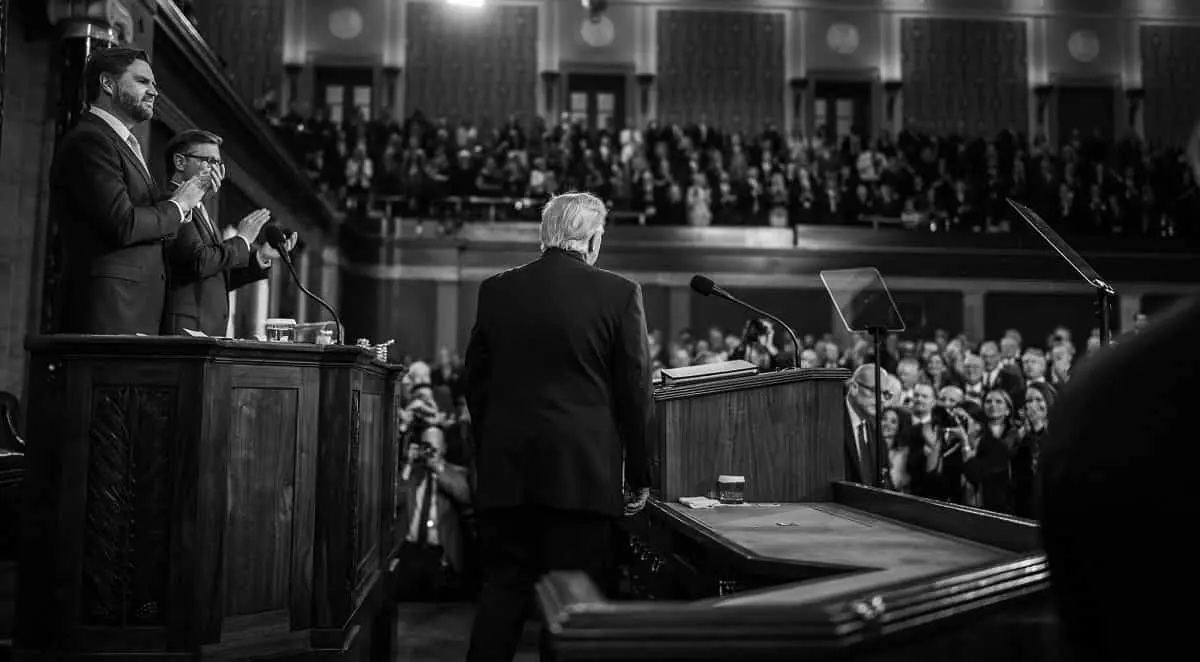
the geopolitical landscape between the United States and Europe entered a critical phase. President Donald Trump’s State of the Union address — the longest in American history — sent ripples across the Atlantic, prompting European policymakers, analysts, and the public to reassess the future of the transatlantic relationship. What European leaders and citizens took away from Trump’s speech reflects a mix of concern, uncertainty, and shifting strategic priorities.
A Transatlantic Message with Mixed Signals
In his State of the Union address, President Trump proclaimed that the U.S. was “bigger, better, richer and stronger than ever before,” highlighting economic claims and asserting a vision of American resurgence on the global stage.
However, European audiences focused less on domestic praise and more on the foreign policy implications embedded in the speech — particularly Trump’s rhetoric on tariffs, military strategy, trade, and alliances. His reaffirmation of tariffs and threats of economic measures against foreign partners — including discussions about tariff mechanisms that could impinge on European exports — immediately resonated with policymakers in Brussels and EU capitals.
Notably, Trump’s address included forecasts of global tariffs replacing income tax systems, an idea that unsettled European economists and trade officials who argued that such policies create uncertainty for global supply chains.
European Strategic Autonomy: From Rhetoric to Reality
Europe’s reaction to Trump’s speech occurred against a backdrop of ongoing debates about strategic autonomy — the idea that the EU should be capable of acting independently of the United States in key areas such as defense, trade, and technological regulation.
Experts have cautioned that Trump’s presidency represents “the biggest test of the EU’s capacity to act” in its history, noting that internal divisions and varying threat perceptions among member states have complicated collective decision-making.
Some analysts view Trump’s assertiveness as a potential catalyst for European unity. They argue that U.S. pressure on defense spending and technology competition might encourage the EU to fortify its own industrial and strategic capabilities. For example, strengthening European defense budgets and deeper cooperation on security cooperation could enable the continent to reduce overreliance on U.S. military support.
Thus, beyond short-term controversies, Trump’s approach is seen by some in Europe as a long-term impetus for the bloc to assert itself more confidently on the world stage.
Trade Tensions and Tariff Wars
Trade has become the most visible flashpoint in U.S.–EU relations under Trump’s second term.
In January 2026, the U.S. threatened tariffs on European allies over the Greenland issue — a controversial geopolitical dispute tied to Arctic strategy and NATO. European leaders, including France and Germany, responded by considering the EU’s anti-coercion tools to defend their markets.
The threat of tariffs was severe enough that European capitals discussed deploying trade “bazookas” — powerful economic instruments designed to retaliate against unfair trade practices.
These tensions contributed to the collapse of progress toward the Agreement on Reciprocal, Fair, and Balanced Trade between the U.S. and the EU, with Brussels suspending negotiations amid fears that newly proposed tariffs could disrupt European markets.
Trump continued to defend tariffs during the State of the Union, claiming they could supplant traditional income tax revenue — a controversial stance that threatens to reshape the U.S.-EU economic relationship.
Security, Russia, and NATO Alliances
One of the most debated aspects for European audiences was Trump’s stance on security and Russia.
The war in Ukraine continues to define European security priorities. Trump’s address referred to ending ongoing conflicts — including Russia’s invasion of Ukraine — but offered few specifics on how U.S. strategy would align with European objectives for deterrence, defense, and long-term stability.
Europeans are watching closely how Trump’s rhetoric on Iran — including claims that Tehran pursued missile capabilities capable of threatening allied territories — might influence NATO’s defense posture. While Trump expressed a preference for diplomacy, the possibility of U.S. military action against Iran has raised concerns in NATO capitals about escalation dynamics and coordination.
Public Opinion and European Civil Society Responses
Trump’s policies have also sparked reactions beyond government walls.
Throughout Europe, civil society movements have mobilized against what they view as growing divisiveness in U.S. politics and its international implications. Protests, notably during the June 2025 “No Kings” demonstrations, brought European citizens together to voice opposition to perceived authoritarian tendencies in global leadership — including in Washington.
These movements reflect broader concerns among European populations about human rights, trade fairness, and democratic norms under Trump’s administration — adding another layer to the transatlantic debate.
The Road Ahead: Cooperation or Competition?
Europe’s takeaway from Trump’s State of the Union is clear: while the United States remains a strategic partner, Europe cannot assume predictable cooperation on issues ranging from trade to security.
Many European leaders recognize the need to engage the U.S. diplomatically while preparing to navigate disagreements robustly and constructively. Whether it’s trade disputes, defense spending, or global governance, Europe’s ability to chart an autonomous yet cooperative path with Washington will shape world affairs for years to come.
Trump’s 2026 State of the Union speech was more than an internal political performance — it was a signal of how the U.S. intends to position itself globally in the coming years. For Europe, the address and the broader actions of the Trump administration have underscored the urgency of strengthening transatlantic ties while simultaneously deepening strategic autonomy.
The path forward for Europe involves a complex balancing act: maintaining vital cooperation with the United States, defending its economic interests, and solidifying its role as a cohesive geopolitical actor on the global stage.