
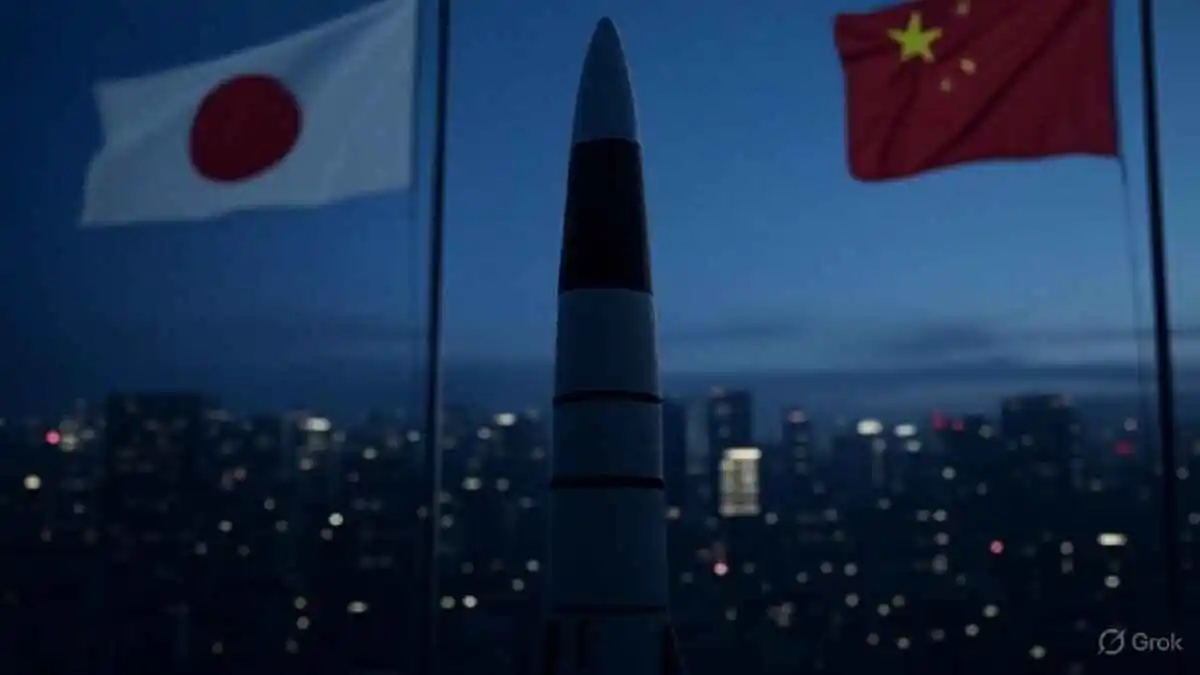
Japan’s government has revealed that medium-range surface-to-air missiles will be stationed on Yonaguni Island, a small but strategically significant territory located just about 110 km (68 miles) from Taiwan, by March 2031, according to defence officials.
Defence Minister Shinjiro Koizumi confirmed that the decision is part of broader efforts to enhance Japan’s air defence capabilities in response to perceived threats from China’s expanding military presence in the East China Sea. While the deployment is still a few years away, the clear timetable marks the first time Tokyo has publicly specified when such systems will be operational.
Japan’s military infrastructure on Yonaguni is already expanding. The island hosts a base of the Japan Ground Self-Defense Force (GSDF) and has seen increased radar installations and surveillance deployments to monitor air and naval movements from nearby Chinese territory — signalling Tokyo’s determination to fortify its southwestern defenses.
Why Yonaguni Matters in the Taiwan Crisis
Yonaguni’s proximity to Taiwan, which China claims as part of its own territory, gives this military build-up a symbolic and strategic significance. Beijing’s leadership regards any external military augmentation in Taiwan’s vicinity as interference in China’s core interests, especially given the island’s contested status and the risk of conflict if China attempts reunification by force.
For Tokyo, however, the missile deployment is framed as defensive and precautionary, aimed at bolstering its capacity to intercept aircraft and ballistic threats and deter potential military provocations rather than initiating confrontation.
China’s Reaction: Diplomatic Condemnation and Economic Measures
China’s response to Tokyo’s announcement was swift and stern. Senior Chinese officials have denounced the plan as a “deliberate escalation” that could destabilise regional peace. Beijing has repeatedly emphasized that the Taiwan issue is a matter of China’s internal affairs and warned Tokyo that crossing its “red line” could carry severe consequences.
Beyond rhetoric, China has already signalled its displeasure through economic pressure. It has imposed export restrictions and controls on dozens of Japanese firms, particularly those linked to defence-related industries, as a retaliatory step against Tokyo’s military posture. These sanctions target both dual-use goods and more symbolic industrial links, highlighting the multifaceted nature of the dispute.
Diplomatic Strain and the Broader China–Japan Crisis
The missile announcement is the latest episode in an ongoing China–Japan diplomatic crisis that escalated in late 2025 after Japanese Prime Minister Sanae Takaichi suggested in parliament that a Chinese attack on Taiwan could constitute an existential threat to Japan — a statement Beijing viewed as provocative. This comment has since driven a cycle of mutual recriminations, travel advisories, bans on tourism, and heightened military vigilance on both sides.
Political analyst assessments emphasise that the situation has extended beyond mere diplomatic spats into the realms of security cooperation, economic retaliation, and regional alliance politics. China has discouraged travel to Japan, impacted trade volumes, and launched cultural reductions, while Tokyo has strengthened alliances and modernised its defence policies accordingly.
Strategic Impact on East Asia and the Indo-Pacific
Japan’s decision reflects a broader strategic realignment in the Indo-Pacific driven by concerns over China’s expanding military power, its assertive actions around Taiwan, and shifting global alliances.
Key strategic implications include:
-
Deterrence Posture: Japan’s missile deployment is intended to increase its defensive reach and deter potential aggression along key regional flashpoints.
-
Alliance Dynamics: Tokyo’s announcement is likely to be closely coordinated with allied nations, particularly the United States, which maintains strategic partnerships in the Pacific.
-
Regional Security Calculus: Other Southeast Asian states and Pacific partners will watch these developments carefully, as they recalibrate their own security policies amid rising Sino-American competition.
-
Economic Interdependence vs Strategic Rivalry: Despite deep economic ties — China has long been Japan’s largest trading partner — geopolitical tensions are increasingly influencing trade, technology exchange, and diplomatic engagements.
The Risk of Escalation
While Tokyo insists that the missile deployment is defensive, many analysts warn that such actions could heighten regional tensions and trigger miscalculations. For China, movements perceived as linked to a potential Taiwan contingency could justify military countermeasures, potentially drawing in allied powers and escalating a local standoff into a broader crisis.
Moreover, critics argue that stationing advanced weaponry close to a flashpoint like Taiwan could force diplomatic partners, including the U.S. and ASEAN members, to take more explicit stances on conflict scenarios that have traditionally been ambiguously managed to avoid escalation.
A Strategic Inflection Point
Japan’s announcement to install missiles near Taiwan marks a significant shift in East Asian security dynamics, blending defence imperatives with high-stakes geopolitical signaling. As Tokyo and Beijing continue to challenge each other’s strategic intentions, the broader region faces a period of increased uncertainty that could reshape alliances, military postures, and economic relations for years to come.
The coming decade will likely test whether deterrence strategies, diplomatic engagements, and alliance structures can effectively manage competition without spiralling into open confrontation — a challenge that matters not just to Japan and China but to the entire global community.