As the world marked World AIDS Day on December 1, 2025, a chilling reality emerged from Pakistan: the country is now home to one of the fastest-growing HIV epidemics on the planet. New infections have skyrocketed 200% in just 15 years — from 16,000 in 2010 to a staggering 48,000 in 2024. What was once largely confined to high-risk groups has now exploded into families, clinics, and playgrounds, with innocent children bearing the heaviest burden.
This is no longer just a health story. It’s a national emergency threatening an entire generation.
How Pakistan’s HIV Crisis Spiraled
Fifteen years ago, HIV in Pakistan was mostly linked to injectable drug use and commercial sex work. Today, the virus is spreading through everyday medical practices gone wrong:
- Reused needles and syringes in under-regulated clinics
- Unsafe blood transfusions
- Poor infection control in hospitals
- Almost no routine HIV screening during pregnancy
The result? Heartbreaking outbreaks where 80–90% of new cases are children under 14.
Recent tragedies tell the story better than statistics:
- Larkana (2019) – hundreds of children infected by a single pediatrician reusing syringes
- Ratodero repeat outbreaks (2023–2025)
- Taunsa, Mirpur Khas, Jacobabad, Shikarpur, Hyderabad, Naushahro Feroze, and Pathan Colony – all hit by child-centered HIV explosions in the last three years alone
In 2023, new pediatric cases (0–14 years) reached 1,800 — more than triple the 530 recorded in 2010.
The Shocking Numbers Behind Pakistan’s HIV Surge (2025 Update)
| Indicator | 2010–2013 | 2024–2025 | Change |
|---|---|---|---|
| New HIV infections per year | ~16,000 | 48,000 | ↑ 200% |
| People living with HIV | ~100,000 | ~350,000 | ↑ 250% |
| % who know their HIV status | <10% | 21% | Still critically low |
| % on antiretroviral therapy (ART) | ~6,500 people | 55,500 people | ↑ 8× (major progress) |
| ART centers nationwide | 13 | 95 | ↑ 7× |
| Children (0–14) newly infected | 530 | 1,800 (2023 data) | ↑ 240% |
| Pregnant women receiving PMTCT | Almost none | Only 14% | 86% still unprotected |
| AIDS-related deaths (2024) | — | >1,100 |
Only 7% of all people living with HIV in Pakistan have reached viral suppression — meaning the vast majority can still transmit the virus unknowingly.
“This Disease Cannot Be Curtailed by Doctors Alone” – Pakistan’s Top Health Official Issues Urgent Plea
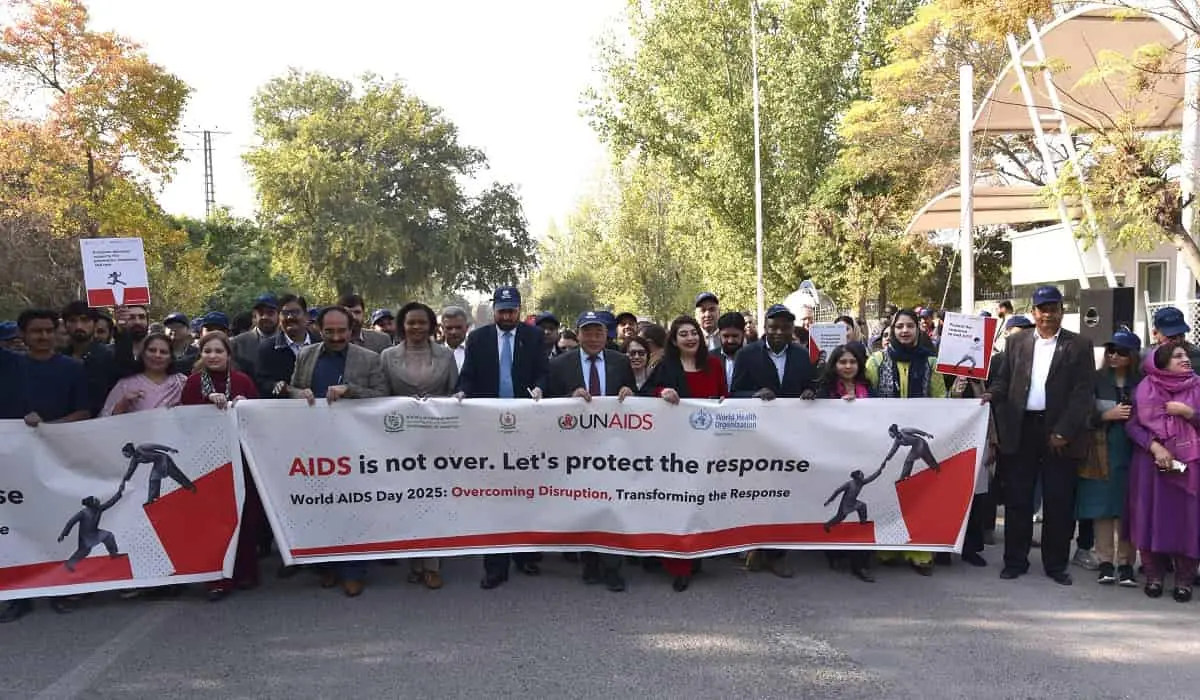
During the World AIDS Day awareness walk in Islamabad, Dr Ayesha Majeed Isani, Director General of Health, delivered a raw and emotional message:
“The discrimination, the stigma, and this disease cannot be curtailed only by us. It has to be the communities, the health regulatory authorities, religious leaders, teachers, parents — everyone. We need to end unsafe injection practices. We need single-use syringes everywhere. We need to educate people. We need clinicians on board. All of us, together, can give the children and adults of Pakistan the healthy, HIV-free future they deserve.”
Progress Exists — But It’s Not Nearly Enough
There are bright spots. Thanks to government, UN, and donor support:
- Antiretroviral therapy coverage jumped from ~6,500 people in 2013 to 55,500 in 2024
- Treatment centers grew from 13 to 95 nationwide
- Free HIV medicines are now available in all provinces
Yet the testing remains the biggest bottleneck. Nearly 8 out of 10 Pakistanis living with HIV still don’t know they carry the virus. Without diagnosis, treatment can’t begin — and silent transmission continues.
The 2030 Deadline: Can Pakistan Still End AIDS as a Public Health Threat?
Global leaders have set an ambitious target: end AIDS as a public health threat by 2030. For Pakistan to get there, experts say the country must:
- Make HIV testing mandatory in all antenatal visits
- Enforce 100% single-use syringes and auto-disable devices nationwide
- Massively expand community-based testing (door-to-door in high-burden districts
- Launch nationwide anti-stigma campaigns involving religious and community leaders
- Triple domestic and international funding immediately
As UNAIDS Pakistan Director Trouble Chikoko warned on World AIDS Day 2025:
“Together, we can still end AIDS by 2030 — but only if we act with urgency, unity, and radical shifts in funding and programming. The international community must step up. We cannot leave Pakistan’s children behind.”
A Generation at the Crossroads
Every day that Pakistan delays decisive action, hundreds more children are infected through a simple injection that should have been safe.
The theme of World AIDS Day 2025 — “Overcoming disruption, transforming the AIDS response” — is more than a slogan. In Pakistan, it’s a last-chance rallying cry.
Because if the world’s fifth-most populous nation cannot protect its youngest citizens from a preventable, treatable virus in 2025, the dream of an AIDS-free generation by 2030 will remain exactly that — a dream.